Showing posts with label reviews. Show all posts

grief and solace conjured aromatically: 'crying in h mart' review


Wednesday, 23 June 2021


SOBBING NEAR THE DRY GOODS, I ASK MYSELF, "AM I EVEN KOREAN ANYMORE IF THERE'S NO ONE LEFT IN MY LIFE TO CALL AND ASK WHICH BRAND OF SEAWEED WE USED TO BUY?"


In the first chapter of Crying in H Mart, we find Michelle Zauner mourning her mother, Chongmi, amid the aisles of H Mart brimming with banchan and rice cakes. Her grief is both summoned and solaced by the aromatics of Korean cuisine that emanate from either side- on one hand, soothed by the familiar pungency of fermented black beans, and on the other, inflamed upon remembering there’s no one left to consult on “which brand of seaweed we used to buy”. Among humdrum shoppers, we witness a poignant moment that cuts deep into the diaspora, capturing the predicament of accessing one’s estranged cultural roots when the only lifeline has been severed.


Crying in H Mart sees Zauner, who is best known for her musical venture Japanese Breakfast, trading in her synths and keys for equally atmospheric prose in a memoir. Emotionally processed yet tender, Zauner dishes into the joys and pains of food through the fertile narrative terrain of grief. Born to a Caucasian father and a Korean umma, Zauner recalls her childhood as a biracial girl living between two worlds- too Asian for the rugged outskirts of Eugene, Oregon, and too white for the cohesive cityscape of Seoul. Without resorting to easy pathos, she relays the ruptures and reconciliations of these cultural plate tectonics; in Double Eyelid, she recalls earning the praise of “aigo yep-peu”- with its twofold meaning of “pretty” and “well-behaved”- for the double eyelid and pale skin she’d inherited from her father. It would be the same reward she’d reap from well-meaning aunts at dinner for dutifully sweeping her plate clean. The aversion she’d eventually develop toward this conflation of moral and aesthetic value mounts tactfully- episodic anecdotes of clashes with her beauty-obsessed mother creep up to a crescendo, a rupturing whose seeds run deep in their cultural differences. Throughout the memoir, we witness how the stability of her Korean heritage was offset by “a complicated desire for whiteness,” a potent force all-too-familiar to those of us born in the diaspora. 


For Zauner and fellow halfies alike, food becomes the love language to be harnessed in resistance to this partial death of cultural identity, hand-in-hand with the death of a loved one. Eschewing heavy-handed facts as well as palliative fictions, the memoir quilts together a candid patchwork of Zauner’s fraught relationship with Chongmi: the joys of a shared penchant for late-night refrigerator scavenging; the severity of their eventual estrangement; the unutterable of cancer, dying and death. She is unsparing and meticulous in her depictions of the indignities involved in Chongmi’s succumbing to cancer. Her final breaths, she writes, bear semblance to “a horrible sucking like the last sputtering of a coffee pot”. Her inability to stomach the more pungent of foods they once gorged on together, “managing only a few bites”. The latter is particularly painful as Zauner, in an attempt to buoy their bonds, begins to decode the once cryptic measurements of umma’s dishes, serving up hearty tteokguk and well-established sick meal, gyeranjjim, only for it all to be “vomited later that night” in a tragically ironic turn of events.


The maturity of Crying in H Mart emerges from a liminal interstice, interweaving two worlds to offer up a Konglish subjectivity that testifies to a childhood in which a mix of English and Korean was ricocheted between family members. Korean words aren’t italicized, and footnotes aren’t offered for every morsel of food. And to insist that this is harnessed as a consciously subversive act to turn cultural hegemony on its head would be to sell short the day-to-day minutiae of diasporic life. Zauner resists privileging one culture over the other, her bilingual introspections glimmering with a dynamic wholeness that is being forged through and in spite of her cultural schizophrenia. 


A viscerally immersive read, Crying in H Mart spurs within us all, in the eye of the storm, a self-reflection that transcends geographic and cultural boundaries. We are urged to cede the comfortable excuses and evasions of ego, to locate solace among the wreckage of a familial fracturing, and to do so with grace, vastness and resilience. Reading the memoir against a backdrop of rising Anti-Asian sentiment, however, we are again shaken by the seismic force of a collective grief whose five stages take on a cyclical formation, where anger becomes overlaid with depression before we ever get the chance to deny. What Zauner reminds us is that even in this absence of touch, unable to hold one another and grieve, we will be found alone together, one arm full of groceries, hungering for a morsel of the homeland. 


Crying in H Mart by Michelle Zauner is out on August 5th 2021 in the UK through Picador.


a tender tale of asian-american travails and resilience: 'minari' review


An immigrant’s heart is a battlefront. Torn between past and present, the home that once was and the home that is now, we are above all most homesick for a place we have never known: a place of stability. It’s the hunger that beckons the uprooting of the Yis, the Korean-American family at the forefront of Lee Isaac Chung’s Minari. With the hazy focus of a memory, the film traces the travails and resilience of immigrants in the lure of America’s ill-defined promises. Indeed, the Korean herb from which the film takes its name is capable of flourishing on the most unforgiving of terrains, its verdant sprouts brimming with hope- the question is whether the same will prove true for the Yis.

It’s the 1980s and Jacob (Steven Yeun) has uprooted his family from the West Coast to rural Arkansas, looking to start afresh. His wife Monica (Yeri Han) hesitantly slipstreaming behind, the Yis pull up at the new home that’s depleted their meagre savings: a remote patch of Ozarks farmland with a trailer perched atop cinder blocks. In a plan equal parts American Dream and Korean crop, Jacob’s convinced he’ll transform this cleared acreage into a lucrative Korean vegetable business. It’s not all that far-fetched, it seems. With languorous, buttery shots of the surrounding foliage, Chung palpably conjures the hope that’s propelled Jacob to this “Garden of Eden”, as he calls it. But in the dim interior of the mobile home, we find Monica less than thrilled to be living out in the boondocks, seeing Jacob’s endeavor as a selfish folly that puts their youngest at risk- seven-year-old David (Alan Kim), who suffers from a heart condition. Her trust wanes one compromise after another, and like David’s heart murmur, it doesn’t register as brutal in a single moment; rather, it accrues gradually into an accumulative force that reveals itself in a restrained muttering of words that cut far deeper. Somewhere in the middle of this simmering tension are their two American-born kids, who are, for now, too entranced by the vats of Mountain Dew in the fridge to take notice of their transitive becomings as cultural hybrids.

Chung is a patient filmmaker- he reveals the Asian-American experience in the quieter interludes, infused with a lived-in quality: supersized bottles of Mountain Dew guzzled for their purported health benefits; racial microaggressions from a white boy at church, asking why David’s “face is so flat”; Jacob’s mockery of the pseudoscience of water divining, boasting that “Korean people use their heads''. Among these vignettes, it’s the arrival of Monica’s cantankerous mother, Soonja (Youn Yuh-jung), which heralds a chain of events that have immigrant audiences lunged back into their younger selves, grappling with a cultural dissonance that becomes intelligible only in hindsight. What cannot be described of diasporic life, Chung understands, must be conjured in the interstice between multiple gazes. Upon Soonja’s entrance, we see Monica strenuously warding off the tears, uttering that primal “ma”. Then there's David, whose Americanised ideals of a cookie-baking granny have him complaining that “Grandma smells like Korea!”. Youn is a scene-stealer as the foul-mouthed force of unmitigated Old Country that eventually wins over David, a reconciliation that isn’t at the expense of her individual identity. If Minari’s final tragedy registers as uncharacteristically extreme for a film that’s otherwise subtle in its observations, it’s held together by Chung’s capacity to return to those quiet yet expressive notes of the Yis’ familial bond.

It’s a rare sight in American cinema- bicultural depictions of immigrant life that resort neither to a rags-to-riches narrative nor a cautionary tale. And that’s why the Golden Globes’ relegation of Minari to a foreign language film stings; it’s a kind of life-imitates-art moment that reproduces the very counter-currents the Yis endured to assimilate. And so it must be asked: how many signifiers of the promised land- the family’s home in rural Arkansas, Jacob’s dreams of being a self-made man, Monica’s longing to assimilate- will it take for Minari and the Yis to be understood as quintessentially American? Chung’s deceptively gentle storytelling, for one, bathes the minutiae of sowing and reaping with a timeless grandeur that resists this Othering.

Minari is released on 2 April on digital platforms.


ten uneasy pieces: digital solidarity, in light of covid-19 and black lives matter - 'we=link: ten easy pieces' review


Wednesday, 10 June 2020


'WE = LINK: Ten Easy Pieces' is available at: http://we-link.chronusartcenter.org/


While brick-and-mortar spaces dwindle in numbers, there is certainly no shortage of frenzied action being taken by the art world to bring culture straight to the doorsteps, contact-free. The appetite for the arts is now being satiated digitally as cultural institutions go virtual, but with such unprecedented uncertainty and diminishing attention spans- the coronavirus pandemic coupled with the revolutionary fervor re-incited by George Floyd’s death- shows of solidarity through art take precedence over mind-numbing satiation. Culture is metamorphosing as it harnesses the language, aesthetics and existential anxiety of contemporary life- a reminder that despite the universality of virus, demographically localized oppressions persist as structural inequalities are not only sustained but inflamed. Traces of the much needed silver lining of solidarity linger in the Chronus Art Center’s most recent online exhibition, WE = LINK: Ten Easy Pieces, initiated as an open call to the international media art community. Employing network-native works, WE = LINK in its entirety is borne from the internet, existing solely within the quadrilateral frames of our devices. The ten networked art pieces, in their totality, serve as a response to “a general state of humanity that is under pressing peril of natural and social disruptions” (Ga, 2020), disruptions of severe systematic failures that are being exposed during the coronavirus outbreak. 

As screen times soar, we are beckoned to come face-to-face with the internet’s sheer penetrative power like never before; long a ubiquitous given, these networks have felt so fundamental to the human condition they were forgettable- only up until our daily routines were disrupted, however. WE=LINK curator Zhang Ga elucidates this transformation, wherein practice precedes theory, in Heideggerian terms; what was once “Zuhandenheit” (readiness-to-hand), a matter-of-fact extension of the self, is now “Vorhandenheit” (presence-at-hand), a phenomenon eligible for theoretical consideration. And at the core of this theorization is an idea recurring in WE=LINK- connectivity. Network native art, in particular, possesses a kind of virtual viscerality that transcends passive viewing, necessarily so in its competition for attention with the constant stimulation of a text message, an Instagram notification or the urgent desire to check the daily COVID-19 stats. Coupled with the work it hosts, the show’s interface design and title limn both this connectivity and bombardment of stimuli. WE=LINK- a subtle play on WeChat, the popular Chinese social media platform- hosts a landing page featuring a circuitry of pale pink chain-links, overlaid with interactive dots which, hovered over, sporadically display artwork previews.


Image
'get well soon!' (2020) by tega brain & sam lavigne

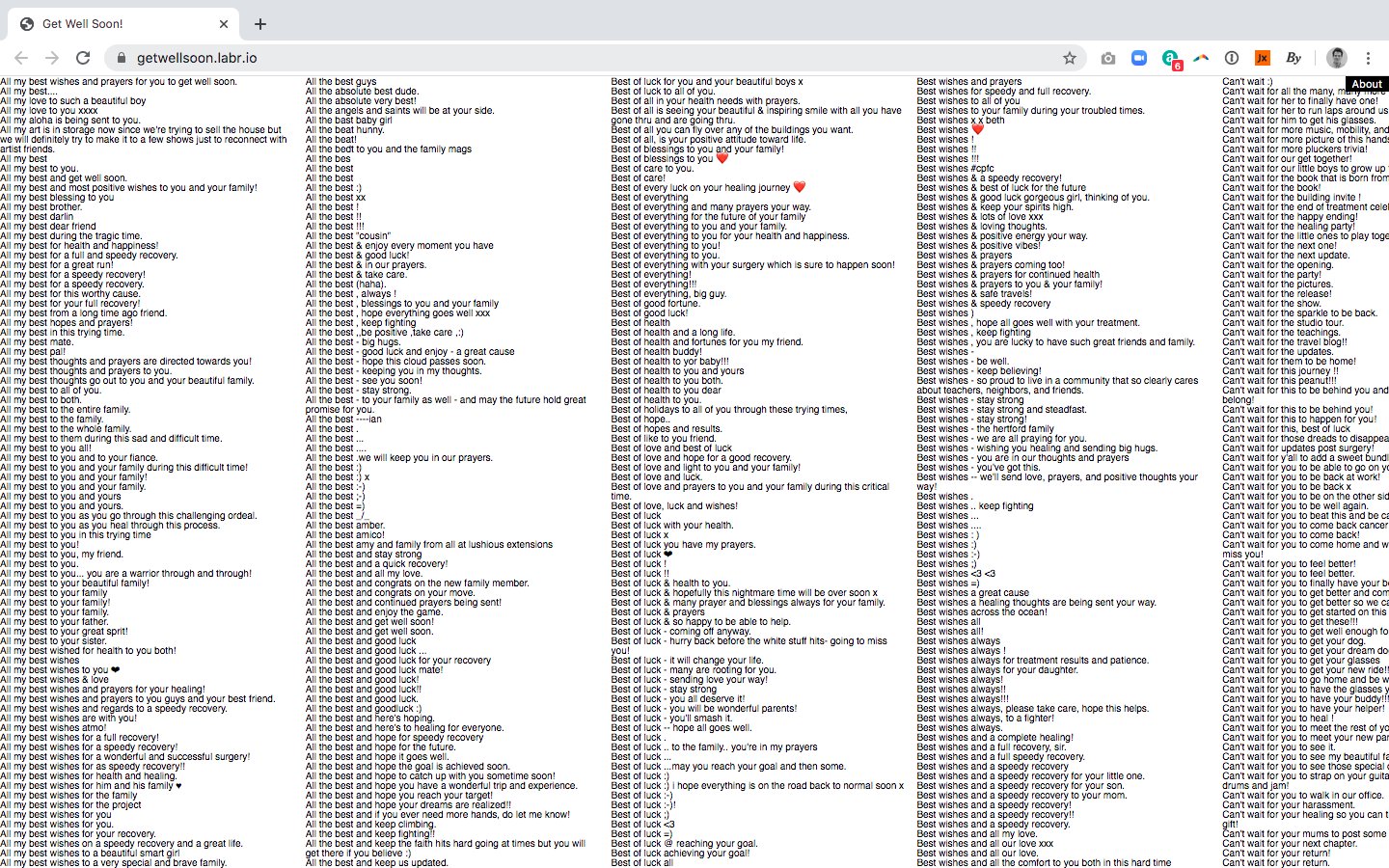
Commissioned by the Chronus Art Center, Tega Brain and Sam Lavigne’s Get Well Soon (2020) employs digital data as a simultaneous critique and show of solidarity. A squint reveals the fine sans serif print on a vast e-card to be the aggregation of some 200,000 well-wishes amassed from medical GoFundMe campaigns. Beneath all the good will of the repeated variations of “hang in there” and heart emojis is a nationwide illness brewing, one which will not be entirely remedied by mutual aid but ultimately by tangible structural change. More than anything, it is an archive that lays bare the festering wound that is a failing healthcare system which values profit and bipartisan debate over the lives of its citizenry. It is an archive that should not exist. 

As if it wasn’t immensely pertinent at the time of the exhibition’s opening, Get Well Soon is a prescient warning in its paralleling of illness and insurrection. The e-card is accompanied by a politically charged essay by Johanna Hedva, likening the nowness and the immediacy of illness to that of revolution: “When we are desperate for change, as we are both in illness and insurrection, our language drains of complexity, becomes honed to its barest essentials” (Hedva, 2020). Swept up in the fervor of George Floyd protests, almost all of which originates from social media, we occupy a liminal space as “the now becomes a joyous defiance of fate” (Hedva, 2020). At some point though, as Hedva notes, the nowness of revolution becomes wedged in between “the past and the future”, a never-ending wait. And what Get Well Soon reminds us at a time of simultaneous mass illness and revolution, as Roxane Gay puts it plainly, is that “eventually, doctors will find a coronavirus vaccine, but black people will continue to wait, despite the futility of hope, for a cure for racism” (Gay, 2020). WE=LINK’s advocacy of the solidarity elicited by digital networks is certainly a sentiment that reverberates in the now. The ubiquity of these networks have undoubtedly enabled individuals to uphold one another in the face of governmental failures. But as the indignation piles on like volatile layers of sediment, one tragedy after another, WE = LINK inadvertently stresses that digital dialogue can no longer serve as an end goal. No matter its immediacy, the internet will not match the viscerality of taking to the streets. And while the silver lining glimmers of solidarity, it no longer entails a return to normalcy- rather, normal is the very thing we must be liberated of.


'WE = LINK: Ten Easy Pieces' is at Chronus Art Center, March 30 onwards.


Works cited

Ga, Z. (2020). WE=LINK: | TEN EASY PIECES 十个小品. [online] we-link.chronusartcenter.org. Available at: http://we-link.chronusartcenter.org/ [Accessed 8 Jun. 2020].

Gay, R. (2020). Opinion | Remember, No One Is Coming to Save Us. The New York Times. [online] 30 May. Available at: https://www.nytimes.com/2020/05/30/opinion/sunday/trump-george-floyd-coronavirus.html [Accessed 8 Jun. 2020].

Hedva, J. (2020). A Text by Johanna Hedva. Available at: http://getwellsoon.labr.io/ [Accessed 7 Jun. 2020].


force and fragility: the kaleidoscopic ecosystems of vivian suter - 'tintin's sofa' review


Sunday, 8 March 2020


January 17 - April 5, 2020 @ Camden Arts Centre, London

Rarely do we see the turbulent forces of nature as sympathetic to mankind’s endeavors. Tempest-tossed and drenched, the subject at mercy of nature always occupies an adversarial position. Yet, when Swiss-born artist Vivian Suter’s lakeside studio in Guatemala was flooded, the foe that is the vicissitudes of weather would come to be a friend. Suter’s practice now flows in harmony with nature’s contingencies; born in Buenos Aires, she relocated to Panajachel in 1982, where the lush rainforest that envelops her would come to forge new meanings for her environmentally-implicated artmaking.
Recognising the near sublime implacability of nature, Suter has come to embrace the al fresco method, hanging her paintings outside in an invitation for metamorphosis, whether that be by exposure to sunlight, rainwater, or her three dogs. This untamed quality of nature is immediately echoed even prior to entering the two galleries that seek to contain Suter’s works. The paintings unapologetically swarm out of the gallery’s allocated boundaries, occupying the walkway in an animated interruption of the white-walled starkness. Upon entrance to the first gallery, one is confronted by a kaleidoscopic ecosystem of paintings swathed in colour; taken holistically, they possess a sentience that echoes Suter’s immediate environment: the rainforest. Densely installed, the unstretched canvases occupy almost every available space across the two rooms, suspended in rows akin to laundry on a drying rack and piled onto one another on the floor like undergrowth. 
Individualizing each painting doesn’t seem to be of interest to Suter- none are titled, signed or dated; rather, they are to be taken en masse, as an ecosystem greater than the sum of its parts. However, that isn’t to say that a closer inspection of each painting isn’t worthwhile. In fact, it brings light to the subtle details symptomatic of the works’ exposure to nature: a frayed edge; a paw print; a paint-encrusted twig. Not solely do the works’ arrangement bear resemblance to a rainforest, but they retain traces of it; in doing so, Suter establishes a permeable membrane between the natural world and manmade one. Thus, in accumulating records of the environments they inhabit, the paintings serve as archives- a feature sustained even after having departed the rainforest. Now, the paintings are subject to the forces of misty North London, with a number of the paintings having been placed in the gallery’s outdoor garden. 
However, this act of decontextualising- or one could argue, recontextualising- inherently comes with certain ethical dilemmas. In displacing such ecological works from their original context to urban world capitals, their sociocultural roots become susceptible to fetishization by Western consumers. And in this current timeline of environmental stresses- especially considering the precarity of rainforests- we can by no means afford to read these paintings as whimsical displays of exotic otherness. Rather, the harshness of nature’s imprints on these works must serve as an urgent reminder that climate catastrophe derives from the Western model of capitalist human activity and not some self-conceived phenomenon. Even within an urban landscape, we are beckoned to come face-to-face with this disconcerting reality; those of her paintings situated in the gallery’s garden, by virtue of Storm Dennis, thrash against one another with a violence that can no longer be dismissed as mere winter winds. 
It goes without saying that the architectural decisions of the Camden Arts Centre are also implicated in this decontextualisation. Housing three galleries characterised by their high ceilings, irregularly placed rooflights and white walls, this architectural model could eschew politicization- yet, Suter’s ecological oeuvre resists being neutralized for purely aesthetic consumption, partially by virtue of self-conscious curatorial choices. As environmentally-implicated work, the reception of Tintin’s Sofa is too ideologically pertinent in its postcolonial reading of ecological crisis to ever be deemed a mere aesthetic experience. As sublime as the display is in its occupation of the gallery, it is more so the fact that Suter’s work- both literally and metaphorically- transcends its four walls that proves to be the most gripping feature of Tintin’s Sofa.

‘Tintin’s Sofa’ is at Camden Arts Centre, London, until 5 April 2020.

sinking to metaphorical depths: 'parasite' review


Monday, 24 February 2020


Wow! This is so metaphorical!


One can hardly avoid describing such an observation as hackneyed and, rather ironically, void of depth. Yet, when that same remark is exclaimed by lead character Ki-woo in Bong Joon-Ho’s class-war satire, Parasite, it is strikingly clever. Long praised for his oeuvre’s allegorical “pertinence” (well, of course, it’s about class!), the sui generis auteur uses Parasite as a vehicle to confront the wishy-washiness of that praise. Under the surface , Parasite cunningly operates as a parodical metacritique of the class-war thriller genre to which it belongs.

As allegorical as it may all seem, Parasite isn’t reliant on some dystopian flight of fancy; rather, its characters inhabit an all-too-familiar stratified landscape. In this microcosm, we encounter two families- the strapped-for-cash Kims and the patrician Parks- in a symbiotic relationship. But whether this symbiosis is one of mutualism or parasitism remains unclear. And in the case of the latter, the household we classify as the parasite, as opposed to the host, serves as a mere echo of our own political inclinations. Bong abstains from spoon-feeding us any discrete identification.

The film opens with a shot descending from ground level to the Kims’ squalid semi-basement home at the rear end of a Seoul street. In this subterranean underbelly, the Kims barely eke out a living as the family’s college-aged son Ki-woo and his sister Ki-jung scurry around attempting to leech off the upstairs shops’ wifi. Almost immediately, Parasite ’s camerawork establishes a literal upstairs-downstairs construct that underscores the Kims’ pitiful position on the pecking order. Then, by a stroke of luck, Ki-woo bags a lucrative tutoring job for the Parks’ daughter, courtesy of a better-off pal’s recommendation and Ki-jung’s knack for document forgery. In due time, the family of four, under dubious premises, are employed for service jobs by the Parks. In their impenetrable manor, the nouveaux riches are far too insulated by privilege to catch onto their schemes. But it’s not all smooth sailing from there; in their aspirational chase for wealth, the Kim clan is forced to confront the fellow workers they’ve displaced- those belonging to the same pack, hungry for a taste of the meager remains of capital that has trickled down from the top.

Parasite is not an idealistic wet dream of progressivism so much as a metacritique of our tendency to search for that progressivism in culture. The film is enlightening, but not in the way it’s been acclaimed as some step-by-step guidebook to class liberation. In fact, during the epilogue when we encounter Ki-woo back in the hovel where we first found him, it feels as if Bong has entirely eschewed any utopian vision of proletarian upward-mobility. Instead, he digs into that festering wound of class warfare with a realist worldview, accentuating the material conditions which birth and exacerbate these divides. At its core, Parasite is a film that doesn’t hesitate to tease viewers virtually drooling at the chance to praise any film with an innocuous “so metaphorical!”. Especially when, for those same viewers, these events exist exclusively within the parameters of the silver screen.


‘Parasite’ is out in the UK on 7 February.

art that returns the gaze: 'data dating' review


Wednesday, 29 January 2020


Ashley Madison Angels at Work in London - !Mediengruppe Bitnik

January 15 - March 1 2020 @ Watermans Art Centre, London


Across an awfully Americanesque McDonald’s drive-thru stands a building emblazoned with gaudy text begging to be noticed. It’s hard to miss when it’s the only trace of colour amongst the lonely streets of Brentford- well, besides that unmistakable yellow glow of the universal ‘M’ from across the road. Again, that’s not the only thing that's universal here. Housed in this building, the Watermans Art Centre, is an exploration of a similarly border-transcending phenomenon- online dating- by several international artists, John Yuyi and !Mediengruppe Bitnik to name a few.

At first glance, it seems like a stark contrast, something amiss- a local arts centre, frequented predominantly by seniors, juxtaposed with a state-of-the-art, hyperdigital exhibit that could easily be branded as a “millennial thing”. But perhaps it’s a sign of the times; as the Internet’s sheer penetrative power comes to feel like a fundamental feature of the human condition, we’re no longer able to classify digital romance as a discrete generational phenomenon. New means of connection are shifting the old paradigms of love, and upon entrance to the exhibition, this is immediately affirmed by Adam Basanta’s assemblage of readymades. 

Standing stiffly in the centre of the room is this interactive assemblage, A Truly Magical Moment. Comprised of two iPhones on selfie sticks facing one another, mounted on a revolving disk, the gadget invites two people to video call each of the phones. Once connected in a virtual face-to-face- voila! The sculpture begins to spin, reaching dizzying speeds while the image of your partner stays in focus. In its perfunctory methodicalness, it’s a bleak recreation of that archetypal scene in romantic cinema: two star-crossed lovers, hands entwined, spinning whimsically in the middle of the dance floor. Gazing amorously into each others’ eyes, the room begins to blur: it’s just you and your one true love. Except it’s two iPhones, and mosaics of 240 flesh-toned pixels. A truly magical moment indeed.

At a point in time where corporeality is no longer a prerequisite to romance, definitions of intimacy are inevitably changing. Yet, despite the Internet’s recent inception, these conversations on love in the digital age don’t feel unprecedented. How could they, when we exist in an era that's borne witness to the birth of an entire online dating subgenre of rom-coms, with all its pomp and circumstance? But while it certainly can be taken with a grain of salt, there’s also a more ominous underbelly brewing that resists the Hollywood treatment. In Data Dating, this disconcerting dimension is literally concealed behind a hot-pink fringe curtain that demarcates the family-friendly from the ‘viewer’s discretion’ section- a section that uncomfortably breeds a sort of passive yet immersed voyeurism.


Behind this veil, audiences encounter !Mediengruppe Bitnik’s Ashley Madison Angels at Work in London: an army of five CGI fembots on mounted screens, with egg-smooth skin and unwavering, beady-eyed stares. It’s a startling confrontation to say the least; you’re outnumbered, one to five, as the cyborg clan returns the gaze you’re expecting to take a one-way course. Referring to the Canadian extramarital dating service, Ashley Madison, the installation deploys the breached user data which revealed the 75,000 female chatbots the service had created to compensate for their disproportionate male-to-female ratio. These bots- crisp, fine-tuned- contrast sharply with the glitchy jigsaws of real humans in A Truly Magical Moment, prompting a reassessment of any preconceived notions on authenticity and what it may entail. But while the screens’ clarity stand in obvious distinction, the line dividing machine from human may not be so conspicuous.


In all areas, preconceived notions seem to be what needs to be suspended; stepping foot into Watermans for Data Dating, one may anticipate something a little ho-hum, watered down to cater to the suburban Brentford family. Yet, with its mishmash of oddities- fembots, disgruntled seniors, a Maccies across the road- Data Dating proves to be a surreal, prodding experience certainly greater than the sum of its parts. 

Data Dating is at Watermans Art Centre, London, until 1 March.

mitski and the politicized vulnerability of 'be the cowboy'


Saturday, 19 January 2019


YOUR MOTHER WOULDN'T APPROVE OF HOW MY MOTHER RAISED ME


BUT I DO, I THINK I DO

AND YOU'RE AN ALL-AMERICAN BOY

I GUESS I COULDN'T HELP TRYING TO BE YOUR BEST AMERICAN GIRL


Mitski by David Lee

Four tracks into Mitski Miyawaki’s new album, Be The Cowboy, she confesses rather cathartically: It’s just that I fell in love with a war. With an astute directness, Mitski’s one-liners don’t shy away from confronting the nitty-gritty of her emotional turbulence, existential angst, and loneliness face-to-face. Her powerful lyricism, combined with a stylistically sophisticated sound, engrain a striking new Asian-American mark on today’s DIY indie scene. Mitski, alongside her newest release, Be The Cowboy, is a bold force to be reckoned with - by all of us. 

Born in Japan with Japanese-American dual nationality, Mitski’s work similarly echoes an inimitable duality- a duality that emerges from her ability to be devastatingly self-deprecating one minute and bold and boastful the next. With her father’s itinerant occupation, Mitski would move frequently, inhabiting a total of thirteen countries prior to settling in New York City. There, she released her first two albums with a characteristic orchestral sound, Lush (2012) and Retired From Sad, New Career in Business (2013). The fifth of her albums, Be The Cowboy, almost serves as a pivot point in her work; whilst Puberty 2, released two years prior, is saturated with heavy distortion, Be The Cowboy assumes a much more thrillingly dramatic attitude, drilled in with bleak organ sounds which manically metamorphose into jaunty, explosive bubblegum climaxes. Abandoning her usual approach of doubled vocals, the matured instrumental work is paired with a heart-wrenchingly vulnerable, yet confident voice. 

Beyond its auditory characteristics, Mitski’s renowned Be The Cowboy serves to effectively subvert the normative categorization of Asian-American women in media. The stereotype of this pigeonholed identity continues to contend that Asian women fall into a distinctive binary - on one end, the hypersexualized, fetishised object ironically lacking in sexual agency, and on the other, the utter antithesis: reserved, meek and subjugated to a position of complete desexualization. A multiplicity of recent Asian female artists have taken tangible measures in debunking the harmful myths perpetuated by centuries of orientalist oppression, and Mitski is no exception- perhaps a hallmark- to this contemporary wave of progress. With bold lyrics such as 'Cause nobody butters me up like you, and / Nobody fucks me like me, it seems she reclaims her sexuality with a straightforwardness that raises an inquisitive brow or two. In Nobody, perhaps the most popular of the tracks, she laments over her loneliness with a humanity and candidness that undoubtedly mirrors our own realities: And I don't want your pity / I just want somebody near me. But this doesn’t make Mitski a “projection”, of which she deems to be an “uncomfortable and dangerous” position; for an audience, it grounds her in reality, manifests her humanity and is a particularly empowering step in demystifying constricting norms held of Asian women. 

Mitski’s entire oeuvre reverberates the truth that ‘the personal is political’, as her mere honesty and vulnerability, intentional or not, refract into politicized statements on much of what the Asian-American experience entails. I guess I couldn’t help trying to be your best American girl, she confesses devastatingly on Puberty 2’s fifth track, Your Best American Girl, a line all-too-familiar to the outsider. In Townie, she triumphantly articulates, I’m not gonna be what my daddy wants me to be, waving goodbye to the omnipresent cultural expectations enforced onto her. Revealing her battles against the internalization of whitewashed ideals, Mitski hits close to home for a large cross-section of society burdened by the onus of constantly striving to fit an archetypal bill.

With Be The Cowboy, Mitski has come to amass an almost cult-like following of outsiders. Ironically united by a common denominator, whether it be the all-consuming wrath of existential loneliness, struggles pertaining to cultural identity in an increasingly divided political climate, or the vengeful post-heartbreak mentality, this crowd of devotees isn’t going anywhere any time soon. Akin to artists like Rina Sawayama and Michelle Zauner of Japanese Breakfast, Mitski is just beginning to reclaim her space as an indie forerunner in dismantling and reframing contemporary ideas of what it means to exist as an Asian woman in a postcolonial world.

angel olsen (live at salon iksv) : a heavy presence


Wednesday, 4 July 2018


On May 3rd, I went to see the ethereal 50s-reminiscent indie queen of our generation, Angel Olsen. Dreamlike and luminescent as ever, Olsen's voice parallels the nostalgia of an eerie 50s radio broadcast, grainy, as if it'd been gracefully filtered through the sieve that is the legacy of an amalgamation of legendary artists, from Lauryn Hill to Brian Eno and David Bowie.

Standing in the humble crowd of 100 or so, the minute Olsen struck that first guitar string, the minute the first note gently emanated from the hefty amps behind her, the energy in the atmosphere metamorphosed rapidly. Striking a chord in everyone's hearts within a beat, Olsen emanates a indescribable quality in the air; she carries a heavy presence with her voice, her gaze; the mere thrill of her just standing there is enough to quieten the room. As always with Angel Olsen, I'm met with insuppressible waterworks and an unnerving trembling of my hands; my heart - open, my ears - open, I'm wholeheartedly entranced. 

Following Unfucktheworld, wherein Olsen gracefully reiterates: I am the only one now, I am the only one now, I am the only one now, she proceeds to counter that sentiment entirely in If It's Alive, It Will, entirely oxymoronic to the aforementioned: 


      I used to think I was the only one
      I used to think I was the only one
      I used to think I was the only one
      But I've learned quite a few things since then
      I've learned that no one ever really is the only one

Undiscerned by the majority of the crowd, Olsen pauses for a minute, chuckling at the paradoxical juxtaposition of Unfucktheworld consecutive to If It's Alive, It Will in terms of lyricism. Acknowledging the ups and downs pertaining to personal growth in her oeuvre presents a beautiful milestone - to have produced so much substance within her work that it showcases the turbulent journey of what it means to drench the art she externalises with emotional truths. It's the small things as such which remain most deeply ingrained in the memory - and surely, it takes quite a lot of poetic license to hold such a seemingly insignificant moment caught in time so near and dear to the heart. 
Meeting her after the gig was an experienced characterised by a muddle of surrealism, anxiety and heartfelt love; nothing I could ever vocally articulate would wholly encapsulate the imprint of her art - the emotional residue clogged up in me - although it was worth an attempt. 


a rushed little painting i'd made for angel
having burn your fire for no witness signed
There's nothing quite like experiencing the presence of Angel Olsen live - her angelic voice reverberates through my life as a tear-jerking hymn, a reminder of all things beautiful, all things which rip through the walls I've spent painstaking years building around my heart.